Showing posts with label Above. Show all posts

Sunday, April 1, 2012

The Beast of the North

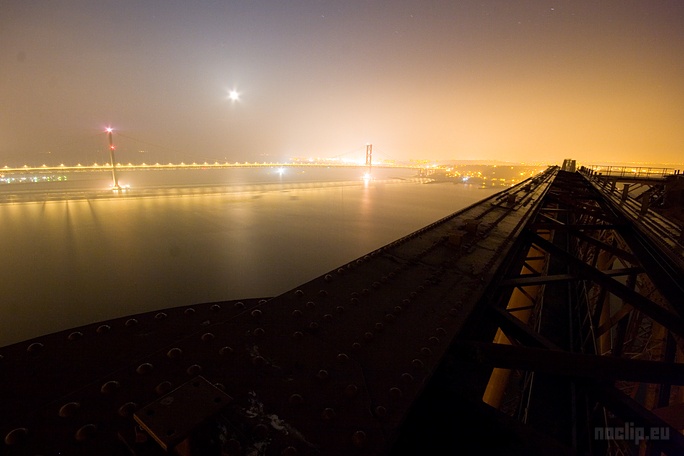
Every bridge has its charm, and each bridge has a story. But after a while, the types of bridges and types of climbs start to repeat themselves - scampering up cables of a suspension bridge, climbing ladders or stairs to the top of a lift structure, scaling the curved beams of an arch bridge. We've long since pretty much figured out the best bridge designs, and tend to stick with the tried and true - suspension, cable-stay, arch, and the various moveable bridges. There are few opportunities to climb a truly unique bridge. One of those opportunities involves a 124 year-old beast of a triple cantilever structure just outside of Edinburgh, Scotland.

Some members of the International Bridge Brigade had been up the north tower of the Firth of Forth rail bridge previously, utilizing the scaffolding that had been in place for years while the bridge was being inspected, repaired, and painted by workers. I arrived with both the benefit and drawback of the scaffolding being some months gone. The benefit being the lack of workers at night. The drawback being that I had no idea how I was actually going to get up the thing. Still, I figured if I couldn't somehow find a way up this giant jungle gym of a bridge, I didn't have any business being in the International Bridge Brigade myself.

Photo courtesy of noclip.eu
Luckily, I managed to hook up with a couple locals who had been eyeing the climb themselves. It ended up being a two-night affair, the second night being accompanied by my friend Steve who had just arrived in town that morning. We went for the south tower, and the road to the summit was truly a team excursion. I dare say if any piece of the puzzle had fallen through, I don't know if anyone would have gotten to the top. Local savvy and recon, bridge knowledge and climbing experience, everyone played their part, and I was very happy to play mine. It's always nice to be a bit more than just a tag-along on these types of trips abroad.
Photo courtesy of noclip.eu
The climb itself can best be summed up as what you might expect of climbing up a bridge over a North Sea estuary in Scotland in the middle of February. Not exactly a walk in the park, but the wind, mist, and drizzling rain only really made the photography a difficult endeavor, not the climb. And I wouldn't have wanted it another way. There is little like the feeling of mounting this Scottish beast with the wind and rain whipping around you and the Forth churning below.

The bridge itself is amazing. When large iron and steel structures started to be built in the late 1800s, many were heavily, heavily over-engineered. Nowadays we know how to do it. Sleek suspension and cable-stay bridges are the norm (witness, for instance, the lovely but perfectly standard 1964 suspension road bridge which also crosses the Forth a bit to the west). But back then you took no chances - especially in light of the recent collapse of the under-engineered Tay Bridge - and reinforced everything up the wazoo, which results in the almost MC Escher-like structure of the bridge. A myriad of supports, latticework, beams, all going off at different angles with seemingly little rhyme or reason. Adding to the surrealness is the wide array of random accoutrements - staircases to nowhere, various ladders placed seemingly at random, catwalks which stop 30 feet from any useful end point.
Photo courtesy of noclip.eu
But the most interesting thing isn't the resemblance to Escher - it's the resemblance to Gaudi. There are no right angles, no perfect rectangles. The entire structure is slightly flanged, giving the climb an eerie, extra-dimensional Alice-in-Wonderland feeling. Take a look at the picture below. You'll notice the bottom of the beams are closer together than the tops. Walking up inside them, I went from having to crouch to avoid hitting my head at the bottom, to needing to climb several feet in order to hoist myself up to the summit at the top. This also leads to a skewing of perspective that, I imagine, is responsible for the kind of optical illusion you see below, where the beams look much steeper than they actually are (it's a 30 degree angle at most).

And when we reached the top of the structure, we noticed another aberration, another example of everything about the structure being just a bit off. The top beams aren't flat, instead being slightly titled outward.
Photo courtesy of noclip.eu
While getting to top is always the main goal, as might be imagined from such a huge, over-engineered structure, there's a lot more to the bridge than just the summit. Catwalks under the railway, empty worker rooms, a 40-foot stone tower guarding the entrance to the crossing, and other various nooks and crannies like the one below. 
Photo courtesy of noclip.eu
We heard the morning's first train rumble over the bridge from in here, and it was time to go. All in all a wonderful time on a truly unique and historic structure. I highly encourage you to check it our for yourself.

Monday, September 19, 2011

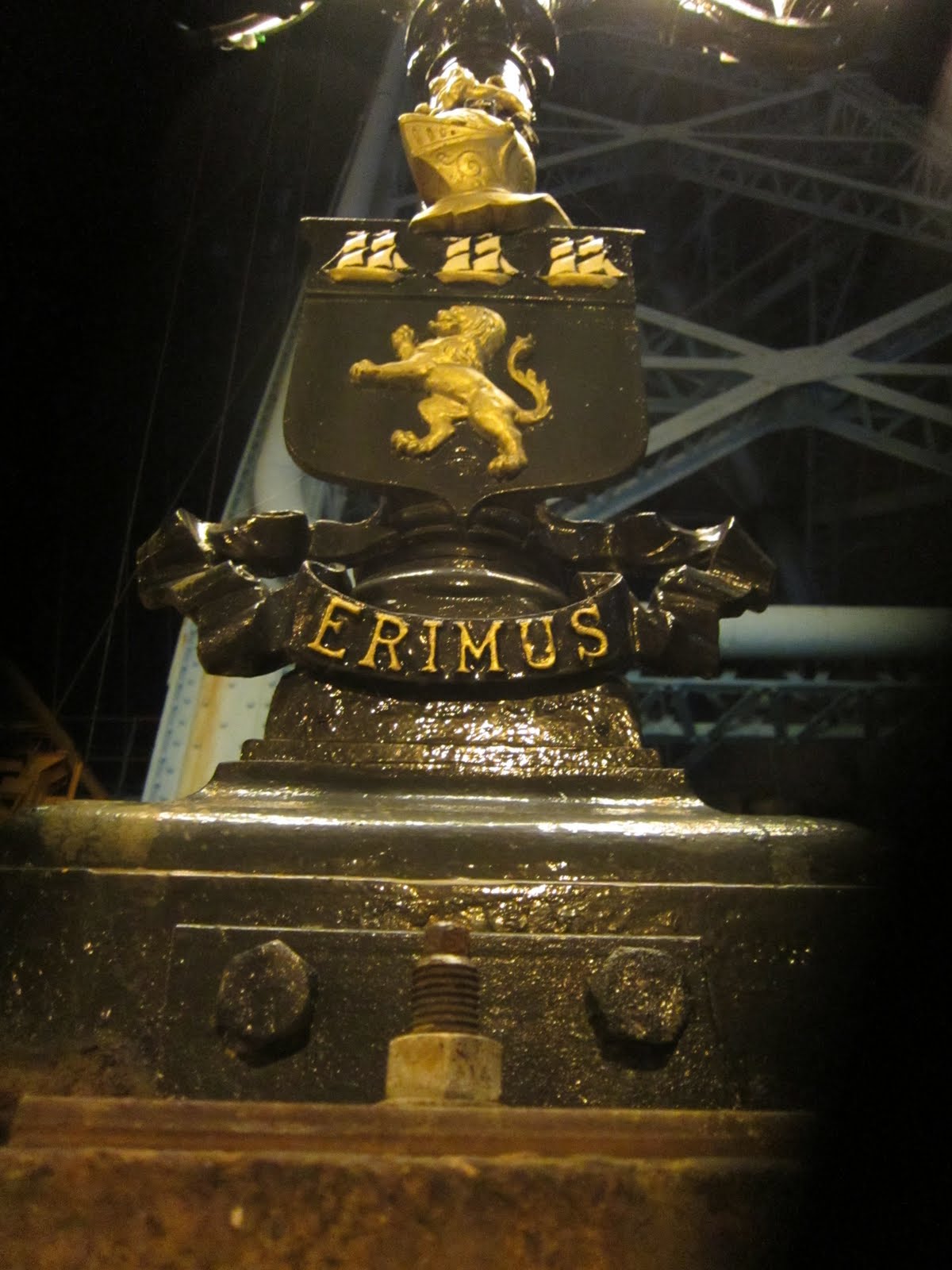
Erimus

I've had a bit of fascination with Middlesbrough for about 8 years now. It's a random story - my introduction to soccer was when I spent the summer of 2002 in Spain, while the World Cup was happening. My first game I watched saw Gaizka Mendieta hit the winning penalty against Ireland. The combination of that and his super-cool name (Basque), saw him become my favorite player, and when he joined Middlesbrough a couple years later, I started following their soccer team. I was pretty excited when, after meeting a fellow explorer here in New York, I learned she was from nearby Hartlepool (a lovely town in its own right). On a recent trip across the pond, I jumped at the chance to head up to the Northeast and finally pay the town a proper visit. And by "proper visit" I of course mean "climbing stuff in the middle of the night."


"Erimus" translates out to "We will be" in Latin. It's an interesting motto for a town whose best days are generally considered behind it - the Boro, as it's known, is one of the old, mid-sized industrial towns of the Northeast that, while not facing quite the same sort of decline as some its counterparts in the rust belt of the United States, has yet to really reinvent itself. Think somewhere like Milwaukee. In short, it's not exactly the kind of place overseas visitors generally make a destination out of.

I only had about 36 hours in the Northeast, but it was enough to confirm my love. I mean, when you waking up to rainbows over picturesque British towns, it's kind of an omen (not to mention crazy Australians in their underwear). 8 hours later we were climbing bridges.


Our appetizer was the Teas-Newport Bridge, the first major lift bridge built in England, and - rumor has it - the host of a recent addition to the (obviously NSFW) sex on bridges club. I hadn't climbed a bridge superstructure in a while and was pretty excited to do so, but started having second thoughts about 2/3 of the way up when I realized that what was flaking off in my hands wasn't just paint, but rusted metal. When I felt a couple crunches beneath my feet, I decided I'd best monkey my way over to the ladder to finish the climb.

Top of the Tees-Newport. Photo by Lucinda Grange 

After this, it was time for the main course - the Middlesbrough Transporter Bridge (don't be fooled - it's still the middle of the night. I shot this photo the following day).

You might look at this picture and remark "wait - how is that a bridge?" And the answer is, "it isn't." That elaborate structure was designed and built solely as a truss mechanism. Wires hang down from a cart that runs in a track under the transverse, and connext with a platform floating on the water. A big cable is attached to this cart from the small building with the chimney that you can see in the foreground on the right. Every 15 minutes or so they take in or let out this cable, which moves the cart, which then guides the platform (which holds up to 9 cars and about 200 people) across the river. In essence, it's several thousand tons of metal put together in order to haul a ferry slightly larger than a boxing ring. Why they don't just have the ferry is beyond me.

Dozens of these had actually been created in the early part of the 20th century, with only a few still working and a few more (like this one I had seen in Buenos Aires) standing but long abandoned. Having failed to climb the one in Buenos Aires, I was pretty excited to get up this one. In true British fashion, they even had a sign politely reminding us of the rules. We followed rules #1 and #4 to a T.

While there's a catwalk for maintenance (and bungee jumping) that runs the length of the bridge, only one side of the bridge has stairs. As such, there's actually no way to cross the river on the structure (which I'd consider a baseline for something being called a "bridge") - unless, of course, you want to do this for a couple hundred feet. 

Snaps getting loose - photo by forsaken

I took the stairs - most of the way. Once we got to the catwalk the stairs ended, but there was still about 50 feet of structure above us. And, as always, you don't stop until you get to the top. Even if your camera sucks.


The next day I wanted to head back to the bridge - to ride it, see it in action. I can't really understand the people who only want the trespassing-adventure part of visiting cities, who travel solely for the purpose of checking various tough-to-get-to places off their list. It's fun, but without any context, it's flying across an ocean just to play around on a big jungle gym. What's the point of exploring, of interacting with this great structure up close, if you don't even bother to experience how it actually works? 

We drove over and paid our 70 pence to take the ride, accompanied by a few cars and what appeared to be a fifth grade field trip.


The ride begins

On the ride back, we asked the ticket-taker if we could see a bit more of the mechanics of the contraption. We were rewarded with a visit inside the machine room where Alan Murray, the Bridgemaster, spent a good half-hour with us explaining how the bridge works. That big spool on the left is used to wind up and let out the cable that moves the transporter mechanism back and forth across the river.


The spool in action


There is no way this would be done in New York or London. We would have asked, they would have said no, and that would have been that. I don't really blame the cities - in large, popular, heavily travelled places many interesting things have a general "lockdown by default" policy. The excuse given (if any) will be usually security or liability, but that's not the real reason - it's to avoid the hassle of eventually being overwhelmed with curiosity seekers. I appreciated the fact that we were in a different paradigm, a different culture, one where the pride that people have in the machines they build, maintain, and operate is manifested by gladly showing them off, not by keeping them smugly hidden away. In fact, for a scant 4 pounds they'll even let you up to the catwalk, weather permitting. You have to follow all four rules though. And I doubt they'll be thrilled if you try to get pictures like the ones above.

Grammatically, and also in the historical context of coming up with the motto, "Erimus" means "we will be" as opposed to "we are" or "we have been." But I started thinking about it in a different way after my 36 hours- "we will be" as opposed to "we will say" or "we will do" or we will (insert verb here)." Thinking about the motto as the motto of a town that goes about it business the way it always has - the kind of town that neither lets this crazy contraption fall into disrepair and abandonment, nor tears it down for a fancy new replacement, but just lets it be.

The bridge turns 100 on October 17th.  If you happen to be in England, head on up for some celebrations -they're going on all month. I wish I could be there for the event  itself though - I do love helping bridges celebrate their centenials. There's also a great book out by Dave Allen about the history of the transporter bridge. You can pick it up in person or online through the Middlesbrough soccer team's store. Go Teesiders!

Saturday, March 10, 2007

Crossing the border

When it comes to landscapes, Argentina is a lot like America. The plains of the Pampas might as well be the Midwest, Tierra del Fuego could easily be the Rockies or even the Pacific Northwest, and even the small tropical corner near Iguazu is mirrored in Hawaii. I headed out from Buenos Aires to the north, around Salta and Jujuy, and felt like I might well be in New Mexico or Arizona. Painted deserts, sparse cactus-filled landscapes - the only real differences are the alpacas and llamas every once in a while.

I also got the chance to do my first bungee jump. It was fairly sketchy - they only had velcro bands around the ankles with no other security - but the fact that it was only about 50 feet or so over a river meant that I most probably would have been perfectly fine if the velcro around my ankles gave way. It was pretty fun - you got dunked into the river at the bottom, then bounced right back out. They also had a great zip line over the river.


After that it was time to head over to Bolivia. A short bus ride, and I encountered the most relaxed border crossing I've ever been to. I was the only gringo. There was a small bridge over a dry creek, with a passport office on the side. Despite it saying "Passport Office" in 6 languages (including Hebrew), I was the only person who actually used the passport office - everyone else just passed back and forth over the bridge, often pushing wagons covered in blankets, completely ignoring the armed border guards.

Once in the passport office a disinterested Bolivian civil servant manning a dusty typewriter stamped my passport with a 30 day visa without even looking at me. I'm not saying this from experience, but if you ever find yourself on the run from the law in Argentina, definitely consider the La Quiaca/Villazon border crossing for making your escape.

Thursday, March 8, 2007

The White Whale Lives

Like captain Ahab, we all have our particular White Whales we chase. Mine is an abandoned bridge in Buenos Aires. I can’t explain it. You’re either one of the small subset of people who see this and drool at the thought of climbing it, or you’re not.


I first encountered the Puente Transbordador (also known as the Puente Avellaneda Antigua) during my first trip to Buenos Aires. It didn’t turn out so great. I don’t really know when I first got it in my head I had to climb this thing - maybe because it was the first interesting structure I ran into in Buenos Aires. As is evidenced from the link above, it’s in a not-so-great part of town, but that’s not why I didn’t want to go at night. I really wanted the views - the Bombanera (the Boca Junior soccer club's stadium), downtown, the port. It’s also definitely not so structurally sound anymore, but I wasn’t really worried about how to climb it or falling - I was worried about getting arrested. More specifically, I was worried about getting arrested in a foreign country.

Knowing the local culture is a big, and underrated, part of going interesting places. In Paris or New York, I wouldn’t have thought twice about climbing the thing. Not because I wouldn’t get caught, but because I would know what to do it I was. In Argentina, I had no clue. Local gossip had it that the police were all lazy and corrupt, but what that meant in practicality I didn’t know. That they’d just let me go? That I should try to bribe them? That they’d haul me down to the station and throw me in jail where I’d quickly be forgotten about? That I’d end up being hustled for thousands of dollars by various bureaucrats and officials to get out of the situation? I never felt comfortable enough doing it during my stay in 2005, but I had resolved that one day, I would. After rolling back into town I had 24 hours to figure it out before I left for Northern Argentina. And in addition to the bridge, I wanted some good views I hadn’t been able to find last time. Luckily, I met an adorable Swedish tourist, and we decided to spend some time seeing what rooftops we could get onto.

When in a strange city (or a familiar one for that matter) hotels are almost always your best bet for easily accessible rooftops. After a couple of false starts, we decided to hit the Sheraton near the Retiro train station north of downtown. In most non-English speaking countries, no matter how you’re dressed, no matter how fancy the hotel, if you walk in speaking English you’re almost always left alone. Here was no exception - we made out way out onto the roof with no problems at all.

Now, when you have a evening in Buenos Aires with the company of a lovely lady, you don’t spend it climbing abandoned bridges. We spent the night dancing the tango in San Telmo, and after my companion had left early the next morning, I resolved to give the bridge one last shot before I had to leave. Unfortunately, sometimes these adventures are anti-climactic. Stationed right out front were these guys: not even cops, but naval officers.


I had one small hope though, which was that maybe this town, like Paris, was sufficiently Latin enough to just let me do whatever I wanted. After all, this is a town where a cabby’s favorite move while stopped at a red light is to pull into the oncoming traffic lane, pull around the cars in front of him, and blow right through the light - cops around or no. I went right up to the naval officers and told them I was climbing up the bridge to take pictures. I wasn’t really surprised when, despite my self-assurance, I was met with a resounding “no you aren’t.”

I still kind of regret not just doing it. Forget about beautiful Swedes, angry naval officers, cultural uncertainly - there's a bridge to climb! Still, during moments like these - and they come for all of us - it’s always good to remember that the White Whale did end up killing Ahab.

Sunday, March 4, 2007

Tightrope on top of Sao Paulo

On my last day in Sao Paulo I decide to head up one more observation deck, the Edificio Italia downtown. The Edificio Italia was erected by Sao Paulo’s Italian community (hence the name), and has both a restaurant and an observation deck at the top. Contrary to what a lot of guidebooks say, you don’t need to go to the restaurant in order to go to the observation deck if you go at certain times of the day. I head up there for the view, but end up encountering Gabriel, one of my companions from PreservaSP, and his friend Guto.

The Edificio Italia used to be the tallest building not just in Sao Paulo, but all of Brazil. That honor now belongs to the Mirante do Vale, a residential building a little ways away. Downtown Sao Paulo is somewhat hilly, and despite being the tallest building it actually ends up being lower than some others due to do it being constructed in a valley. Still, we decided to see if they’d let us up on the roof.

Sao Paulo is kind of schitzophrenic when it comes to residential security. Middle-class people tend to live in 30-40 story high-rises surrounded by fences, sometime topped with barbed or even electrified wires, and staffed 24-7 by security guards. You might think this would make for difficult access to the roofs of residential buildings. But no, we simply go up to reception and ask, and 5 minutes later a janitor is escorting us up. The elevators have an interesting transport philosophy - they stop halfway between two floors, with either a half-flight walk up or down stairs to get to the floor. This leads to half as many potential stops, and at least theoretically, less transportation time.

We go to the top floor, walk up a flight of stairs, and the janitor unlocks the door. But we aren't on the roof yet. It turns out the top five stories don’t exist. Not empty floors, but non-existent floors. No floors, no ceilings, no walls. Just five-foot wide ledges surrounding nothing. We get up to the roof, half of which is actually a Helicopter Landing pad. The view is spectacular.

Top 5 stories of the Mirante do Vale

Helicopter landing pad on the roof


View northeast of the Edificios BANESPA and Banco do Brasil


View South - you can see the antennas of Avenida Paulista off in the distance

Looking down on the Viaduto Santa Ifigenia

The janitor hangs out while we go trampsing onto the other half - the aforementioned five-foot wide ledge. No guardrails, no nothing, with a 50-foot drop on one side, and 500-foot drop on the other. I cannot imagine anywhere in the United States letting us do this - for free no less.


No liability insurance - no problem!


Guto checking the camera

Guto and Gabriel

We hang out for a while, tip the janitor 10 Reals (about 4 dollars), and head back down. One more reason to love Brazil.

Monday, February 26, 2007

How to arrive in Rio

For anyone traveling to Brazil, my advice is this: you’ll probably fly into Sao Paulo’s international airport. Stay two or three days in Sao Paulo, and then fly to Rio. If you fly directly to Rio, or if you transfer from Sao Paulo’s international airport to Rio, you’ll end up flying into Galeao airport, north of the city. However, if you go from Congonhas, Sao Paulo’s domestic airport, you’ll be rewarded with one of the most spectacular flight descents in the world. The ascent from Sao Paulo isn’t bad either - you get to see just how vast the city really is. The only drawback is that Congonas doesn't have the greatest safety record.

Sao Paulo-Rio is the second-most traveled flight pattern in the world (Madrid-Barcelona is number one). Don’t worry about reservations - flights leave at least once an hour, and are usually more like once every half-hour. There’s even a dedicated ticket desk for “buy & fly” purchases -which shouldn’t cost you more than $100 US.

Now, don’t get on the next plane - at least not if you can’t get a window (that’s the whole point). Wait until the one after- you should pretty much have your pick of seats. Although both sides actually have great views, my advice is to sit on the left-hand side window. Rio’s domestic airport (Santos Dumont) is a little two-runway job right next to downtown. This isn’t the difference between flying into JFK and LaGuardia - flying into Santos Dumont is basically the equivalent of flying into the Wall Street Heliport.


Not only are the views astounding (and way better than my disposable-camera picture above), but you can grab your stuff and walk right into the middle of Rio. The subway - which will take you as far south as Copacabana - is only about a 15 minute walk through downtown.

Wednesday, February 7, 2007

Hanging With the Pope

We headed out of Naples for Rome. Our stated mission was to break into the oldest sewer in the world. But there was other stuff to see along the way. You don’t go to Rome without planning some appreciation for the two great historical institutions that have had their headquarters there: the Roman Empire and the Catholic Church.

The first Catholic site I went to was St. Peter’s Basilica . In addition to being a historic, artistic, and architectural marvel, St. Peter’s actually has a remarkable amount of public access. In fact, you can see five different levels at one point. After checking out the interior, I headed up to the top.

I took the stairs the whole way. After a few hundred steps, you’re out on a balcony on the inside overlooking the alter.From there, you head out to the lower roof.

Then a few hundred more steps and you’re rewarded with great views of Rome from the viewing terrace on top of the dome, which was designed by Michelangelo as one of his last works.

he walk up itself was actually pretty fun. There’s about a dozen different types of staircases along the way, and at one point you actually have to learn about 20 degrees to the right while walking, to adjust for the slope of the dome.

The other two levels are below. Underneath the alter is the tomb of the past popes, which is publicly accessible whenever the Basilica is open. And underneath that level is a fascinating archeological site. Tours are given semi-regularly, and we were lucky enough to catch one in English.

Before there was a St. Peter’s Basilica - in fact before there was a St. Peter - the area west of the Tiber river was mainly a burial place. Underneath the Vatican is an entire “City of the Dead” - catacombs filled with Christian, Jewish, and Pagan burial sites. Over the years it’s been excavated, and now has periodic tours where you can also see the burial place of St. Peter. Our guide told us the long twisted take of discovering St. Peter’s remains - basically, since the Vatican’s nightmare was to not find St. Peter’s remains below the alter where they were supposed to be, excavation was held up for centuries. Eventually, remains were found matching the age, sex, and expiration date of the Basilica’s namesake. The final kicker that led the Vatican to declare they were St. Peter’s remains? Despite an abundance of hand and finger bones, there were no foot bones found. Legend has it that St. Peter was crucified upside-down. The easiest way to take a dead body off an upside-down cross? Chop off his feet at the ankles.

A lot of people mistakenly think that St. Peter’s Basilica is the seat of the Bishop of Rome - A.K.A. the Pope. Actually, that honor is held by St. John Lateran - or “The Cathedral Archbasilica of the Most Holy Savior and Saints John Baptist and John the Evangelist in the Lateran.” Cathedral because it contains a Cathedra, or seat of a Bishop. Archbasilica because as the seat of the Pope, it’s considered above all other basilicas. Most Holy Savior because all Patriarchal Basilicas consider Jesus to be the primary patron, with whoever they are named after (Paul, Peter, the Johns, and the Virgin Mary), as secondary patrons. Saint John the Baptist and the Evanglalist because it was actually dedicated twice, and they decided to keep them both. And in the Lateran, because the location is the site of the former palace of the Laterani family.

I decided to head to St. John’s right after my visit to St. Peter’s. And after that, I decided to try and make a Grand Slam of the four Major Basilicas. I headed to St. Paul’s Outside the Walls next (which is supposedly above the burial place of St. Paul). St. Paul’s is most noteworthy for having a portrait of every Pope in history. When there’s no more room for another Pope, it signals (obviously) the end of the world. There’s eight spots left. For centuries, the Roman Catholic Church would not let any Non-Catholic Churches in the city of Rome. The name of the first one, an English language Anglican church? Why “St. Paul’s Inside the Walls” of course. I finished off the Grand Slam with a visit to St. Mary Maggiore, about a half-hour before it closed.

The next day we went to see the Vatican Museum (best known for the Sistine Chapel with the famous ceiling by Michelangelo). The scene in the Chapel is half funny, half pitiful. It’s unbelievably crowded, and despite the prominently displayed “flashbulb with a slash through it” signs, you keep hearing is the guards saying “no flash, no flash” in a resigned voice about every 10 seconds.

In addition to the Vatican Museum, we also saw the Pope. It wasn’t too tough - you head to St. Peter’s on Tuesday, the Swiss Guards give you tickets (free of charge), and you show up the next day.

The whole thing was hilarious. The Pope reads a short statement in about a dozen different languages. Then after each time he reads it, he basically gives a shout-out to whoever happens to be there that speaks that language. If a group from a church in Uruguay is visiting (which they were), he’ll say something like “and I wish to welcome the congregation of St. Mary’s from Montevideo, Uruguay” after he’s done reading the statement in Spanish, and the aforementioned congregation will stands up and cheer and wave Uruguayan flags. Repeat for everyone else that’s there. At one point, I kid you not, a Marching Band stood up and played a few songs after their organization had been given a shout-out. Then after all of that the Pope blesses everything in the room, and that’s a wrap. It’s basically the same as going to a rap concert, but instead of “Is Brooklyn in the House?” it’s “is St. Stephen’s Church of Bratislava, Slovakia in the house?” And as said by Pope Benedict XVI instead of the Method Man.